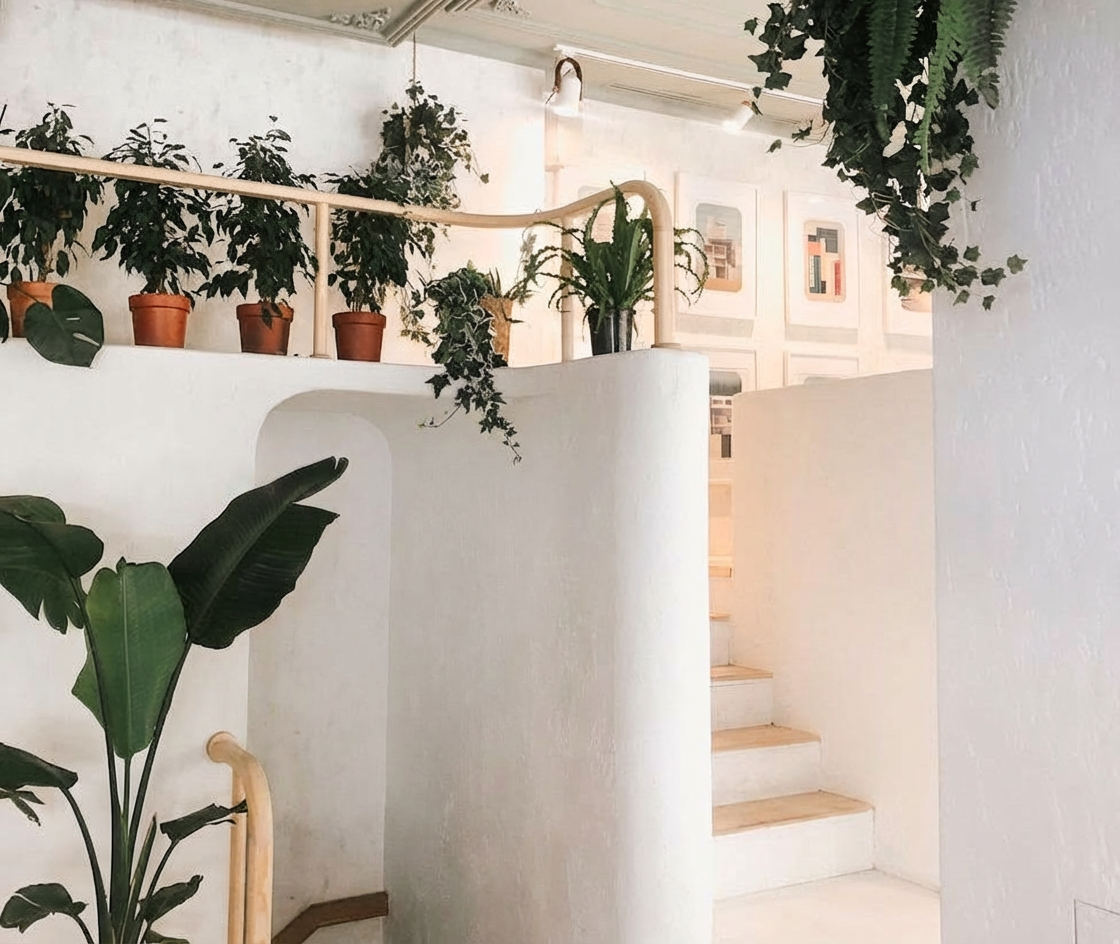
Imagine walking into a room and instantly feeling calm, energized, and grounded—without even realizing why. Sunlight streams through a window, bouncing off warm wooden floors. A gentle water fountain whispers nearby. A cozy nook invites you to pause, while a view of the horizon entices your gaze. You’re not just seeing a pretty room—you’re experiencing biophilic design in action.
Humans have an innate connection to nature, shaped over millennia as we and our evolutionary predecessors developed within the natural world. This concept is known as biophilia, a term popularized by the biologist and evolutionary theorist Edward O. Wilson. Design scholar Stephen R. Kellert later explored how this inherent bond can inform the spaces where we live, work, and learn.
At its core, biophilic design creates environments that respond to our evolutionary need to connect with nature—even when we are surrounded by concrete, screens, and the pace of modern life.
The Heart of Biophilic Design
Kellert organized biophilic design into several guiding elements. Each offers a way to weave nature into daily life — sometimes boldly, sometimes subtly, but always meaningfully.
Environmental Features
This is the most straightforward — bring in direct experiences of nature. Plants, water features, natural light, fresh air, even animals can make a space feel alive. Think potted gardens, living walls, fountains, aquariums, natural ventilation and airflow, views of the outdoors.
Natural Shapes and Forms
Nature rarely works in straight lines or 90-degree angles. Mimic the curves, textures, and geometries found in the natural world. Arched, rounded, and biomorphic forms in rugs, furniture, and decor resemble natural structures and living organisms.
Include variations in pattern, color, and texture. Our brains evolved in environments that were dynamic but patterned — rustling leaves, flickering firelight, shifting clouds, rippling water. This gentle variability is naturally regulating for our nervous system, as these subtle patterns create what researchers call soft fascination, a kind of effortless attention that allows the brain to rest and restore.
Think fractal patterning and botanical motifs in textiles and wall coverings, repetition with subtle variations, dynamic lighting, and materials with innate variations, such as wood, cork, stone, wool and ceramics. These elements bring in information richness — just as nature is complex but organized, so should design provide enough variety and detail to be interesting without overwhelming the senses.
Natural Patterns and Processes
Reflect nature’s rhythms, variability, and gradual change. This could mean catching shifting daylight with a reflective mobile or water feature, syncing artificial lighting to support circadian rhythms, or employing operable windows to introduce seasonal air and weather patterns.
Humans find comfort in the passage of time. Mixing old and new materials — or letting surfaces show wear, patina, or weathering — honors the natural rhythms of time. Think wood that deepens in color and grain, leathers that soften and darken, and metals that oxidize or polish with wear.
Prospect and Refuge
Humans are hardwired to seek environments that balance safety with opportunity for exploration. Imagine a rock outcropping or cave high on a hillside: our ancestors could survey the surrounding landscape, spotting predators, locating water or food, all while remaining protected from the elements. This phenomenon of prospect and refuge refers to the simultaneous experience of being sheltered yet aware of our surroundings, typically involving a combination of expansive views and enclosed spaces, which together are deeply comforting at a subconscious level.
Even minor design moves like a seating nook near a window, a sightline that guides the eye into the next room, or a staircase that disappears around a bend all tap into this natural inclination. Sunlight and larger interventions — think skylights, balconies, atriums, carefully placed openings and alcove seating — all play an important role in creating environments that feel open yet safe.
Place-Based Relationships
Have you ever returned to a special place after a time away and felt that full-body sense of love and belonging?
Topophilia refers to this affective bond between people and place, representing a deep sense of belonging and mental well-being derived from an environment that carries personal, cultural, or ecological meaning.
By connecting interior design to local ecology and culture, we bring the benefits of topophilia indoors, turning a space into a place. Regional materials, native plants, historic or ecological motifs, as well as color palettes inspired by the surrounding landscape create places that feel more grounding, authentic, and personal.
Why It Matters
Spaces that embrace biophilic design don’t just look good — they feel good. Research links nature-connected environments to reduced stress, improved focus, enhanced creativity, and better overall health outcomes. In short, biophilic spaces support human flourishing. They transform buildings from static containers into active partners in well-being.
Bringing Biophilia Home
You don’t need a full renovation to begin. Small shifts can have a meaningful impact:
- Add plants or fresh flowers. Create clusters and use hanging planters or floating shelves for an immersive experience.
- Maximize natural light whenever possible. Position mirrors to reflect light and views from windows.
- Use natural materials—wood, stone, linen, wool, woven goods and textured ceramics.
- Integrate family heirlooms and second-hand pieces that have aged elegantly.
- Create a cozy nook where you can pause, observe, and feel grounded.
- Add a suncatcher to a window that receives direct sunlight.
- Use smart bulbs to recreate the warm hues of firelight in the evening, programming them to gradually dim during your wind-down period.
- Visit a flea or artisans market to look for artwork that reflects your local environment.
Even subtle changes can recalibrate how a space feels.
Biophilic design reminds us that the natural world isn’t somewhere “out there.” It can live within the spaces we inhabit every day—quietly supporting our nervous systems, sharpening our attention, and helping us thrive.
Leave a Reply